
Copy Moon Joy
How four humans have conveyed the ineffable

In my last semester of college, I took a course from British poet Geoffrey Hill on the ineffable.
This man —whose entire vocation was words — spent the semester exploring the limits of language. In particular, we focused on how humans struggle to communicate experiences with love and experiences with the divine.
And, it seems, the moon…
Artemis II has met every definition and nuance of awe: what you feel when you experience something “vast, wondrous, or beyond your ordinary frame of reference.” Have you noticed how often people have talked about tears or goosebumps while following this mission? These are biological expressions of this powerful emotion.
Four astronauts on behalf of eight billion humans witnessed the far side of the moon. NASA didn’t just send up any scientists. These astronauts are also artists and poets and ambassadors of humanity.
Stunning technology sent these humans into space. But simpler technology — their human eyes and hearts — translated what that meant for all of us back on planet Earth.
Sarah Noble, NASA’s Artemis lunar science lead, said that NASA had plenty of camera images. And yet “the human eye is just a fantastic instrument, and we’re hopeful that they’ll be able to see things like, subtle color differences, subtle texture differences, things that we don’t necessarily see in our images. The point is to use their eyes and their brains to get new things that we haven’t seen in our images.”
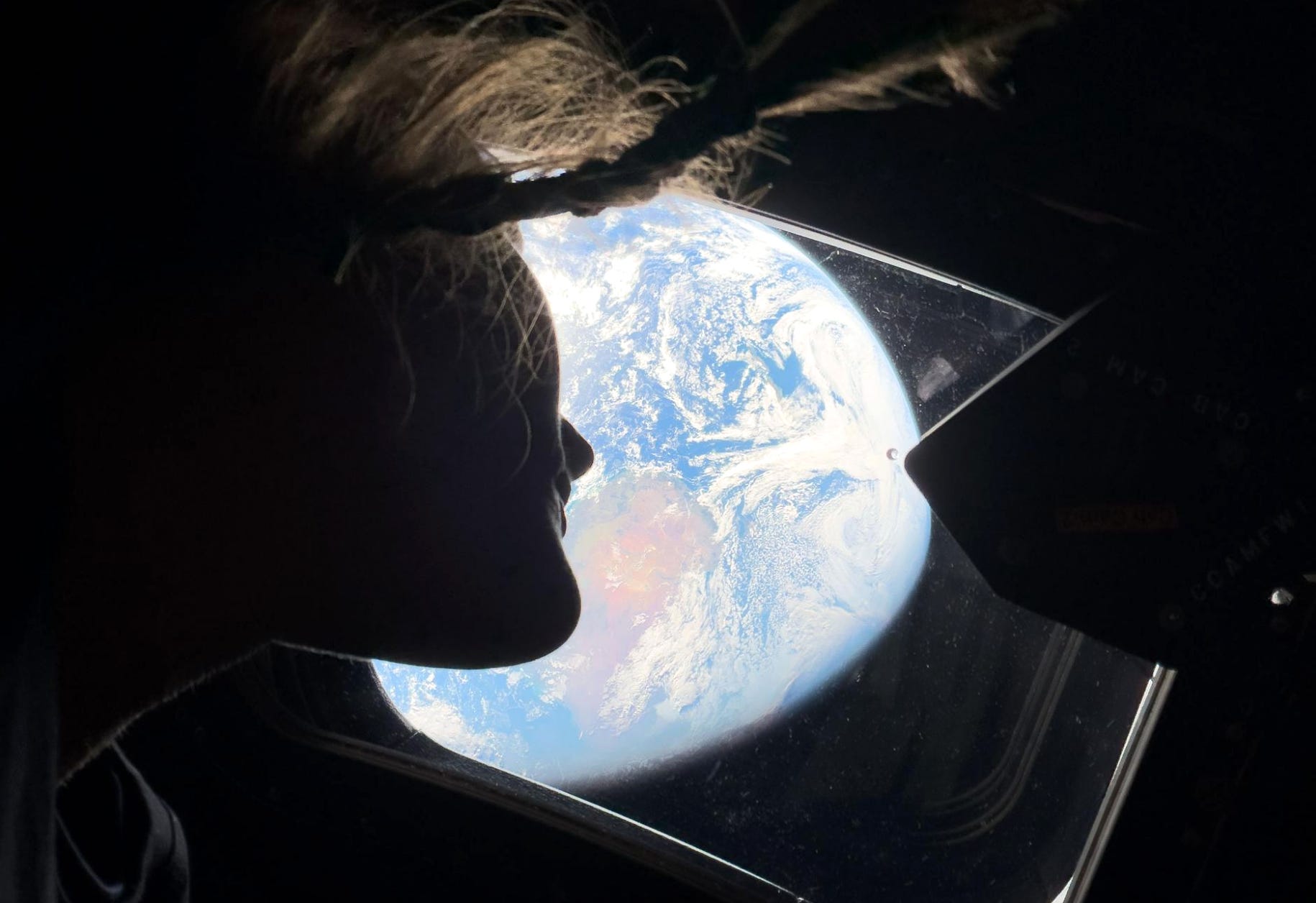
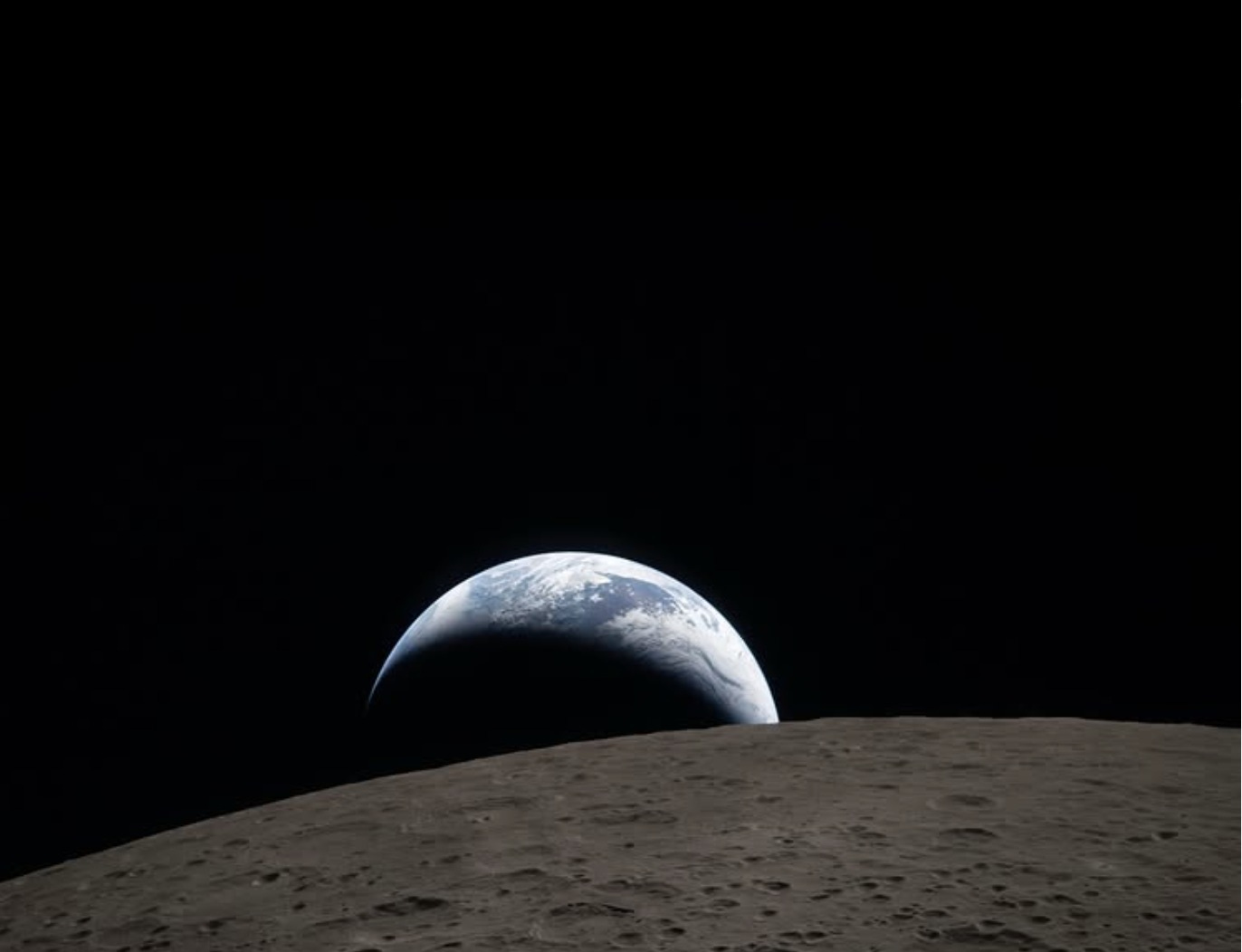
Messages from the Moon
Here are a few of my favorite words that hurtled through space back to Mission Control.
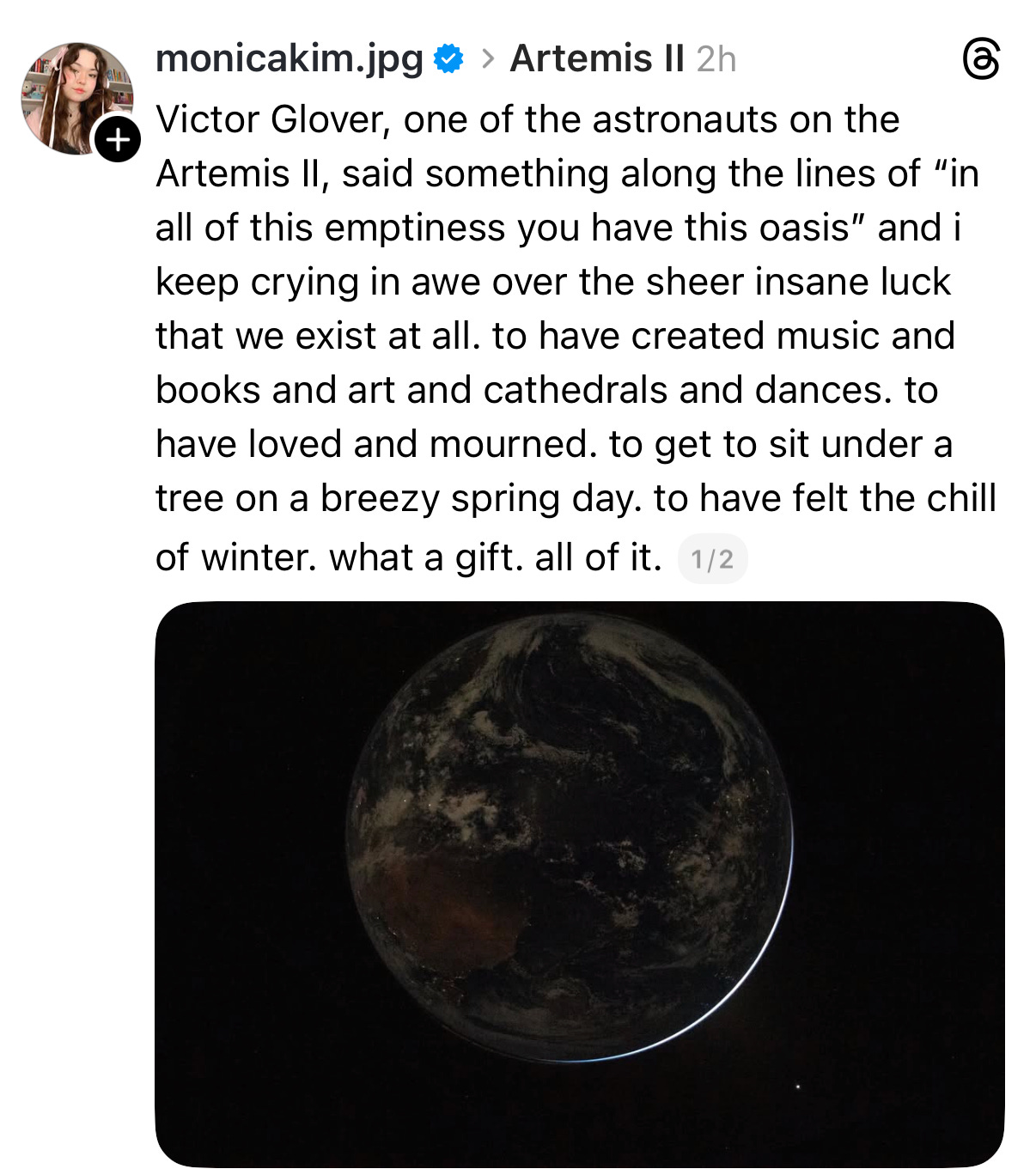
Pilot Victor Glover:
“In all of this emptiness, this is a whole bunch of nothing, this thing we call the universe — you have this oasis, this beautiful place that we get to exist together. I think as we go into Easter Sunday thinking about all the cultures all around the world, whether you celebrate it or not, whether you believe in God or not, this is an opportunity for us to remember where we are, who we are, and that we are the same thing, and that we’ve got to get through this together.”
Commander Reid Wiseman:
“This is a magnificent accomplishment to be up here, to see the moon, to see the Earth, and to know that we are between those two celestial bodies. The Earth is almost in full eclipse, the moon is almost in full daylight, and the only way you could get that view is to be halfway between the two entities. It’s just it is truly awe-inspiring up here.”
Mission Specialist Christina Koch, after regaining communications:
“It is so great to hear from Earth again. To Asia, Africa and Oceania, we are looking back at you. We hear you can look up and see the moon right now. We see you, too. When we burned this burn towards the moon, I said that, ‘We do not leave Earth, but we choose it.’ And that is true. We will explore. We will build. We will build ships, we will visit again. We will construct science outposts. We will drive rovers. We will do radio astronomy. We will found companies. We will bolster industry. We will inspire. But ultimately, we will always choose Earth. We will always choose each other.”
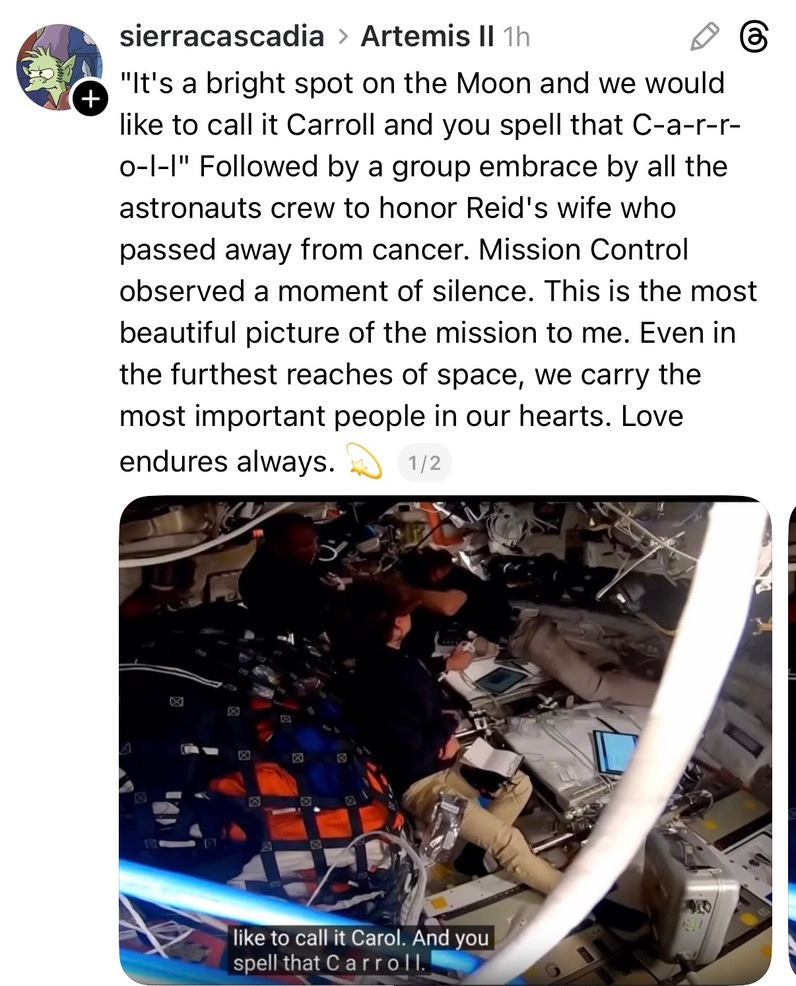
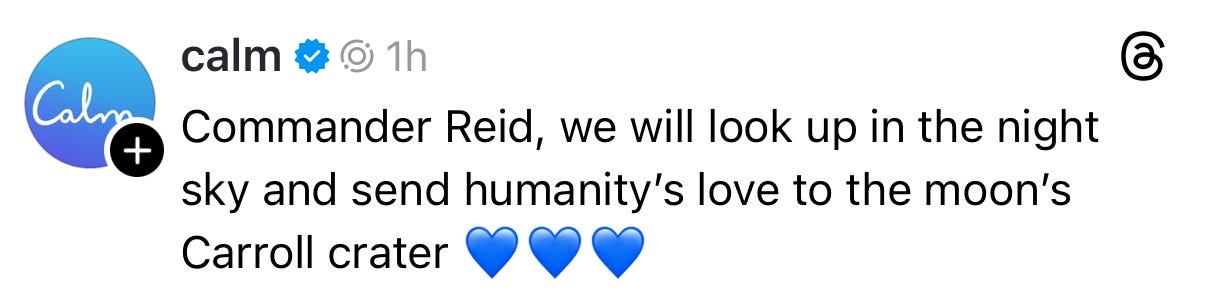
Astronaut Jeremy Hansen, in suggesting they name a crater in memory of Wiseman’s late wife Carroll.
“It’s a bright spot on the moon, and we would like to call it Carroll.”
As the team rounded the moon, knowing they would lose communications for several minutes, they signed off with:
“All of you down there on earth and around earth. We love you from the moon.”
“Houston copies. We'll see you on the other side.”
Finding Words Where No Words Exist
Wiseman — despite all his eloquence — said he lacked the words to describe the experience and asked mission control for “20 new superlatives.” And Glover noted, “Humans probably have not evolved to see what we’re seeing. It is truly hard to describe.”
When asked what words she would use to describe this ineffable experience, astronaut Christina Koch perhaps answered with just one: “Humility.”
As I described in this Boston Globe Magazine article, awe and humility are closely linked. When we experience wide-eyed wonder, that feeling activates what researchers call our “small self.” It reminds us that we are part of something larger than ourselves and that there is always more to learn and understand. It reorders our perspective and helps us feel — in our smallness — more connected to the ineffable mysteries of love, humanity, the universe and the divinity that runs through it all.
Gratefully,
Deborah
Deborah Farmer Kris * www.parenthood365.com
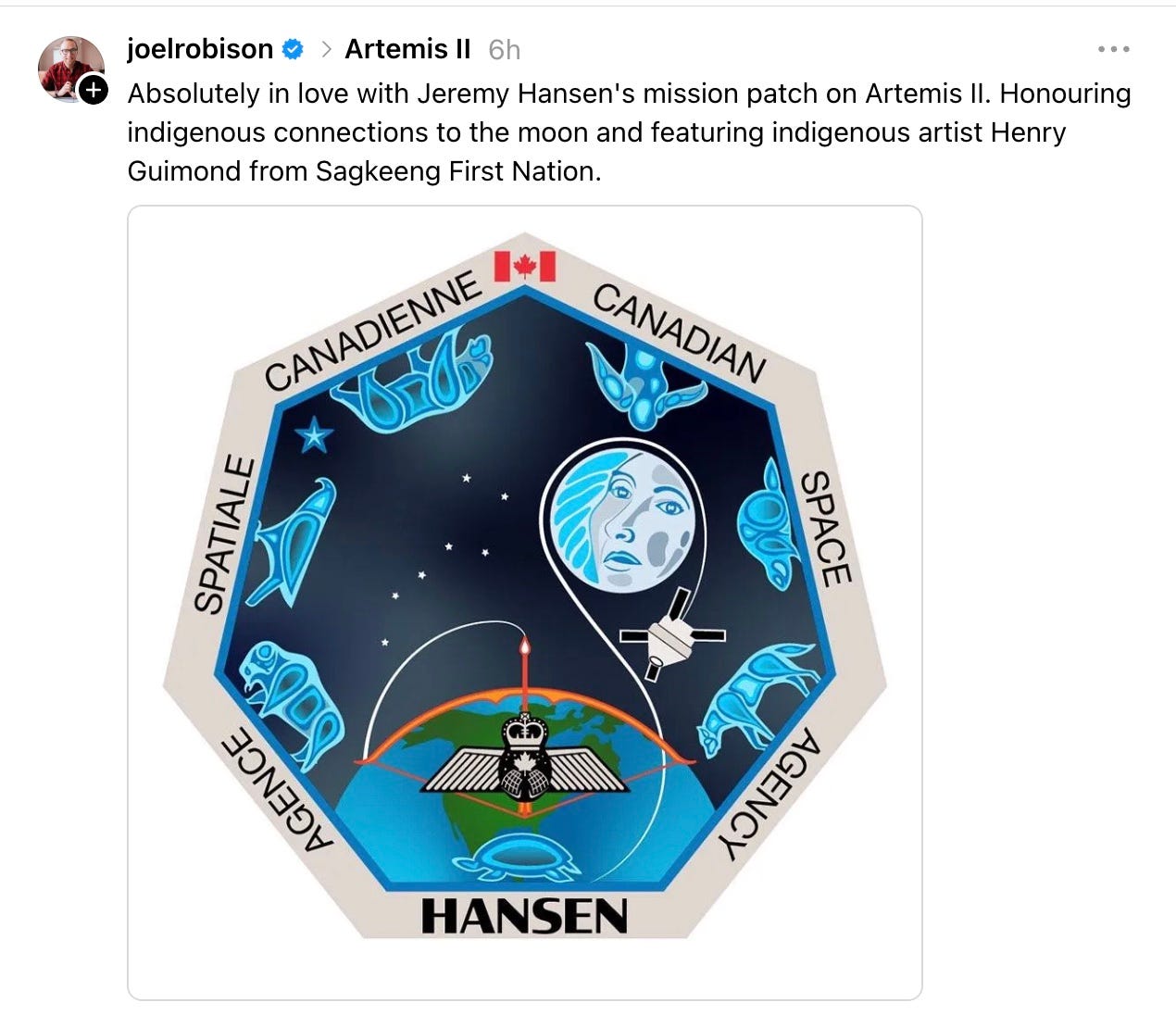
P.S. Here are a few of my favorite posts about the Artemis 2 mission from social media.


Thank you Deborah! This is perfect! And I think my favorite thing is reading what people find to say when they have an experience beyond words. Love this collection of your words and words from across the universe.
My husband is by far the bigger space nerd than I. I'm a biology/psychology kinda person; he loves physics and astronomy. Without him, I likely would have paid zero attention to this mission. With in, I sat on the couch last night and watched 4 astronauts communicate back to Earth, in dang near real-time, their impressions. As you so eloquently stated, their sense of awe,wonder, and joy is on full display and it's a marvelous thing.