
Fruit Flies Are Tiny Miracles
And yes, this has something to do with parenting

Cross-posted at Constant Wonder | BYUradio
Last night, I grabbed a glass, mashed up a banana, sprinkled in some yeast, and placed a paper funnel on top.
“Umm . . . what are you doing?” my son asked.
“Creating a fruit fly trap for the kitchen! I should teach you to make them — it’s in your DNA.”
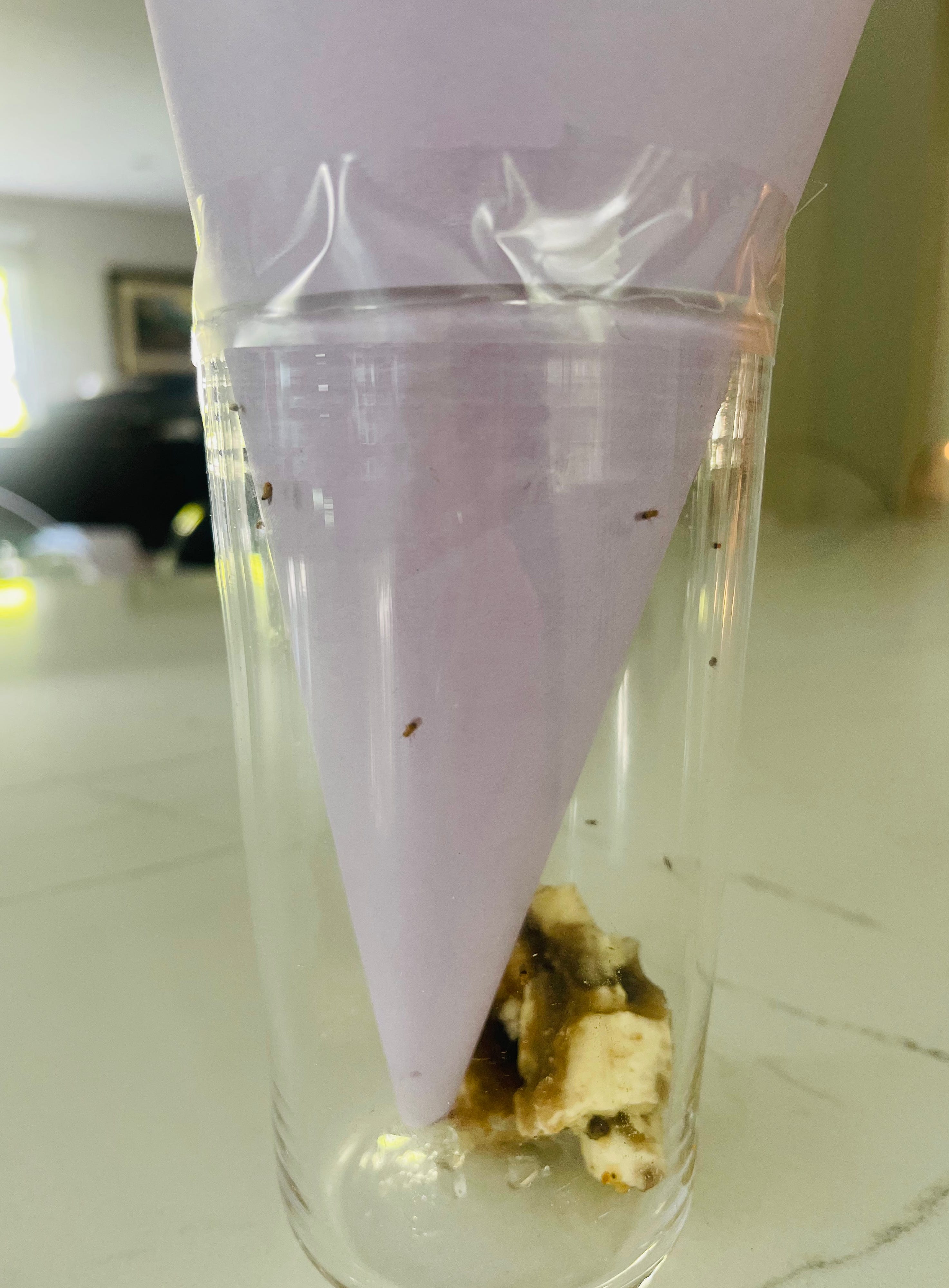
My dad would have called me on my imprecise language: skills like this are not heritable. He is the one who taught me how to catch fruit flies. He caught fruit flies for a living. Kind of. Dad was a geneticist who studied drosophila DNA.
I was the only kid I knew who spent vacations catching fruit flies in a remote mountain range.
My brother and I would help dad prep the bait (banana and yeast) and hang cartons of this mixture on trees around the La Sal mountains. He gave us each a “fruit fly sucker” — a glass tube attached to a long rubber tube that draped around our necks. Some thin netting separated the glass from the rubber, allowing us to “suck up” a fly without inhaling it. We then gently “blew” our captives into bottles for transport back to his lab at BYU.

When I visited his lab as a kid, he would pull a bottle of flies from his fridge, subdue them with a hint of ether, place them under a microscope, hand me a paint brush, and let me move them around as they slowly roused.
Really! I did this dozens of times. I can still tell the difference, on sight, between a male and female fruit fly.
Here are some stunning facts about these creatures.
They are the celebrities of genetic research! They share a surprising number of genes with humans — about 75% of the genes that cause diseases in humans are also found in the fruit fly.
“How is that possible?!” you ask. “They are bugs — and only about a millimeter long.” It’s true! Humans have about 24,000 genes, and fruit flies have a whopping 14,000.
Because fruit flies only have a life-span of about 40 days, this species gives scientists a fast-forward button — allowing them to study evolution and disease across generations. In terms of generations, 30 years of fruit flies = 200 years of mice!
That’s why we were in La Sal. My dad was studying the evolution of a group of flies that was physically isolated from others of its kind (so he could later write up scintillating research papers such as: “In Situ Hybridization Analysis of Chromosomal Homologies in Drosophila Melanogaster and Drosophila Virilis.”)
Remember how I said I could spot the difference between male and female flies? That’s because females have white abdomens. BUT! A few species have evolved so that the females now have darker abdomens, like the males. Why? Scientists think this adaptation helps them reduce the amount of unwanted male attention. Now that’s an evolutionary advancement!
Why am I thinking about this today — besides a fruit fly infestation in our kitchen that I’ve now solved?
This week, I’m on the Constant Wonder podcast to talk about my book “Raising Awe-Seekers: How the Science of Wonder Helps Our Kids Thrive.”
I had never met the host before recording this episode. So I was completely unprepared for him to start the conversation by sharing a story — a story that left me gasping in surprise and in tears.
A story about my dad, the guy who helped me see the wonder in what most of humanity considers a tiny pest.
I’ll let you listen in here to hear the story for yourself.
Cheers,
Deborah
P.S. Wanna hear one of my dad’s favorite jokes?
“Time flies like the wind, but fruit flies like bananas.”
You are welcome.

This is an AWEsome post! My first reaction to fruit flies was eewwww. But now I know how to catch them! And I loved the joke!
It was such a delight to have you on Constant Wonder! And also to know that there's a place to keep getting your perspective.