
Laughter helps teens thrive. Really.
What a Harvard Center's study reveals about adolescent flourishing

When my 12-year-old came home from school yesterday, I caught his eye.
Me: Hey, wanna rematch?
Him: Can you handle being demolished twice?
Me: Try me.
Fifteen minutes later, Toadette (me) hurled a blue shell just before Cow (him) crossed the finish line in Mario Kart World. He yelled “NO!” but his face looked gleeful as I did my victory dance around the family room.
I love laughing with kids.
A while back, I reconnected with one of my old fourth grade students — now in his late 20s. He had three distinct memories from that year:
When I started laughing so hard while reading the book “Skinnybones” aloud that I had to go into the hall to collect myself.
When he was struggling with one of those complex logic problem worksheets about determining the contents of a box, and he yelled out, “Just open the damn box?!” And instead of getting mad, I started to laugh and ripped my paper in half and soon the whole class was ripping and laughing and we all went out for extra recess.
When the class secretly decided we would all dress as “Annie” characters for the Halloween parade — but only if I agreed to put on a bald cap and play “Daddy Warbucks.” I did — and this kid donned a curly red wig and another classmate made up choreography to “Hard Knock Life” and we put on an impromptu performance.
Play is key to learning. Perhaps you’ve heard this quote from Fred Rogers:
Play is often talked about as if it were a relief from serious learning.
But for children play is serious learning.
Play is really the work of childhood.
I love the sound of tweens and teens laughing together.
My son and his friends still naturally fall into play when they are together — all kinds of play: marble runs, shooting hoops, Manhunt, Catan, Uno, Nintendo, Capture the Flag, Dungeons & Dragons, throwing a football, air hockey, trampoline tricks, MadLibs, LEGOS.
So I was completely fascinated by a new study out of The Human Flourishing Program at Harvard University. They conducted a longitudinal study of 22,000 adolescents seeking to identify school-based practices that are associated with student flourishing.
Guess what rose to the top: PLAYFULNESS.
More precisely: “Laughing with other students, experiencing a sense of playfulness, strengthening social relationships, teachers using humor in class, and regular social interaction with teachers and staff.”
As they wrote in a post on LinkedIn:
"The research team looked at about 50 school-based practices. The practices with the greatest impact tended to center on social relationships and humor.
That matters because flourishing is not only about academic performance or mental health in isolation. It includes happiness and life satisfaction, physical health, meaning and purpose, close social relationships, and character and virtue.
For schools, one implication is simple but important: students need time and space to connect, laugh, play, and build real relationships with peers and trusted adults.
Take a look at this chart:
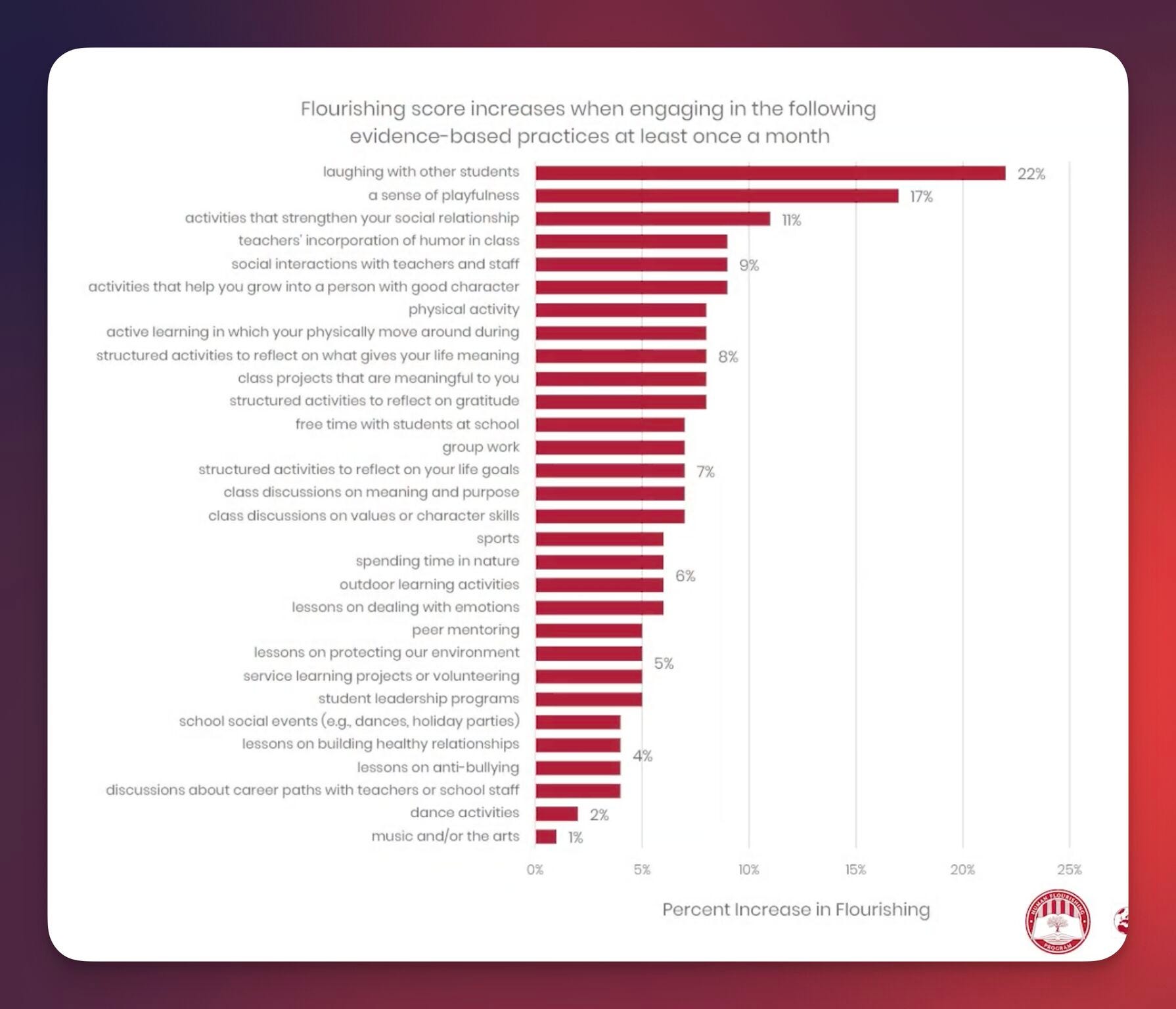
What’s most striking is that this is not elementary or preschool kids. These are adolescents.
But one might argue that teens need play more than ever. Fred Rogers said that, “Play is a child’s most important means of communication,” and I’d add that teens often communicate most while playing. They don’t have heartfelt conversations on demand with their parents. It’s the off-handed comment that comes after singing a goofy song together in the car. It’s the “talking about the day” that trickles into racing Mario and Peach. It’s the chat that happens while cleaning up after Boggle and root beer floats.
It makes me think about a conversation I had with child psychologist Dr. Katie Hurley (Katie Hurley, DSW, LCSW) back in 2020.
Sometimes parents express concern that their teen “isn’t coming to me for support.” But they are, Hurley told me.
“They’re just doing it in a way that you don’t like. When they’re venting or sniping at you over little things – there it is! They are trying to hand you their feelings. They’re projecting outward because those feelings are uncomfortable and they don’t know what to do with them.”
They are still seeking connection, though, she said — and it’s often around play. “Play is how kids connect at all ages,” says Hurley. “It’s a reason teenagers will say, ‘Dad, would you shoot hoops with me?’”
Playfulness is an overture — like the call and response of their baby years when they would drop a toy from the high chair and giggle while we picked it up. Play. Laughter. Blasting a song in the car. Throwing a baseball. Getting a manicure together. Teaching the dog to do a silly trick. Family movie night. Impromptu ice cream “room service” while they are studying for a test. “Come watch this clip from M*A*S*H!” Meme sharing. Stupid, stupid dad jokes.
Play is connection. Connection is flourishing.
Cheers,
Deborah
Deborah Farmer Kris * www.parenthood365.com

This makes so much intuitive sense and it's nice to see it validated through study. Plus, having a sense of humor is SUCH an underrated soft skill, it's great to practice with our teens.
This is huge. Huge, HUGE, huge! This -- playfulness, laughing, banter -- is how so many boys connect & they are so often instructed/told/punished into stopping that behavior in school settings.